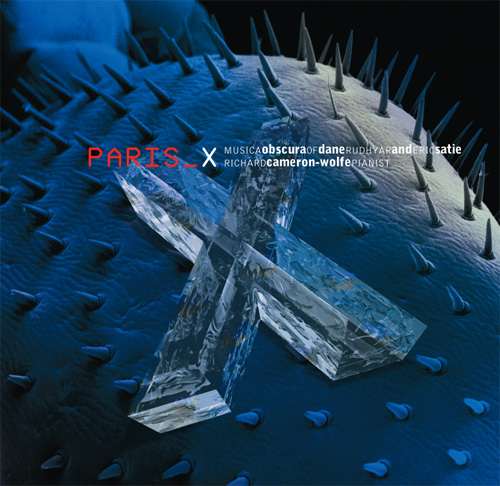
Paris-X Liner Notes

Musica Obscura of Dane Rudhyar & Erik Satie

Paris-X Liner Notes
Paris X brings together music by the X-patriate Dane Rudhyar (1895-1985) and the X-centric Erik Satie (1866-1925), two Parisians whose personal acquaintance was slight but whose music and artistic vision offer a fascinating tapestry of similarity and difference. Satie, at first belittled as a minor talent and plagued by charges of insincerity and incompetence, has emerged as one of the most individual and most loved figures in French music: he became a leading inspiration to a whole generation of avant-garde musicians following the veneration accorded him by John Cage in the 1940s and ’50s. In contrast, after a run of early successes and years of substantial (though still under-recognised) compositional achievement, Rudhyar’s reputation has followed a very different spiral: discouraged by the climate of musical taste in the neoclassical 1930s, which did not value his dissonant, quasi-mystical idiom, he virtually abandoned musical composition between 1935 and 1976 and devoted most of his energies to astrology. His rediscovery by a younger generation of musicians in the 1970s precipitated the beginning of a late period of composition and, belatedly, the recognition of his importance in American ultramodernism.
    At first glance, Rudhyar and Satie offer a study in contrasts. Satie was the older of the two, but seems the younger at heart (“I came into the world very young in a very old time”, he once wrote). He was born in Honfleur in Normandie in 1866 to a Norman father and an English mother of Scottish descent (which accounts for his full name, Eric Alfred Leslie Satie). A serious composer whose music was equally at home in the café-cabarets of Montmartre, the world of avant-garde ballet and absurdist film, or in the service of the sui generis religiosity of his “Rose+Croix” period (the time of Uspud), Satie was a man of high eccentricity and possessed a uniquely inventive wit: he could by turns be charming, irascible and quarrelsome. As an artist he strove to free music from the grandiose excesses of romanticism: his mature compositions bear such titles as The Dreamy Fish, Three Pieces in the Shape of a Pear, Flabby Preludes (for a dog) and Dessicated Embryos. Rudhyar was born Daniel Chennevière in Paris in 1895, to a family of mixed Celtic and Norman ancestry, and died over ninety years later in San Francisco. He came to America at the age of twenty-one, styling himself as a artist-savant, and became known as a composer, a poet, and an expert on what would today be called esoteric philosophy and comparative religion. Like Satie, he left a significant body of writings and published over fifty books, most of them on astrology. His music is characterised by an epic grandeur quite different from even the “serious” side of Satie.
The two men developed distinct attitudes to Paris, the city where they both initially made their mark. Rudhyar was born there, and grew up in an affluent part of the eleventh arrondissement. As a precocious adolescent he gravitated toward the musical institutions of the day, befriending persons of influence at the journal Revue S.I.M. and at the music publishers Durand et Cie. But his experience of the great city at the height of its glory led him to a surprising but determined conviction: that European culture, and Paris amidst it, was a world in decline, and the only hope for the future lay in escape from the old world to the newer civilization of America. All his life he held to an intuition that had come to him one September day, watching the whirling leaves in a forest on the outskirts of Paris: that human cultures, like the natural world, have seasons—periods of growth, maturity, decay, and rebirth. He felt he was living through the autumn of Western civilization, a period of decadence. The creative individual, he said, had a choice, either to remain amidst the beauty of the decaying world, like a leaf in autumn, or to be blown like a seed across the ocean and be embedded in the fertile soil of a New World. In 1916 he made up his mind, and left Paris for New York. He would not return to France for nearly half a century.
    ImageSatie, in contrast, was a Parisian by adoption and by preference, having been brought to the city at the age of twelve to live with his father and stepmother following the death of his grandmother, who had raised Satie and his brother. Unlike the young Rudhyar he had a horror of Parisian officialdom, developing instead a consuming passion for the city’s café and cabaret culture. In 1887 he took up residence in Montmartre in a room near the famous Chat Noir cabaret, where he was briefly employed as pianist and conductor. Plagued all his life by poverty, he moved first to smaller accommodations “to escape his creditors,” then in 1898 to the southern suburb of Arcueil, where he remained for the rest of his life, living in a single room to which no visitor was ever admitted. He would walk into Paris and back each day, in all weathers, stopping off at numerous cafés en route to drink and to compose.
    Neither man had much patience with musical academia. Satie was accepted as a piano student at the Paris Conservatoire in 1878, at the age of twelve, but loathed the seven years he spent in what he described as this “local penitentiary.” One teacher’s report from these years dismissed him as “a quite insignificant pupil,” while his piano teacher Émile Descombes called him the “laziest student in the Conservatoire.” (Five years on he reached the intermediate piano class of Georges Mathias, who called him “worthless.”) He seems to have been a gifted pianist, but rather lacking in motivation and lazy about practicing. Rudhyar likewise had little formal musical education, but was drawn to the Paris Conservatoire as an eighteen-year-old to study counterpoint (much the same motivation would lead Satie back to formal musical study at the Schola Cantorum at the age of thirty-nine). Because of his mother’s acquaintance with the composer and pedagogue Emile Pessard, Rudhyar was allowed to attend classes at the Conservatoire without being formally enrolled—fortunately so, as he found himself “completely unimpressed” by the teaching and soon abandoned his studies. By that time, Europe was at war.
    Only slender evidence exists of any meeting between the two men. Satie evidently got to know of the precocious young Rudhyar (then still known by his birth name, Daniel Chennevière) and seems to have preferred to keep his distance. In a recently discovered letter to an unidentified woman, undated but probably from 1914, Satie wrote: “Je suis venu mercredi, pour vous saluer. Je perçus le jeune Chennevière: cela me fit fuir...” (“I called around on Wednesday to say hello. But I noticed young Chennevière there and promptly took to my heels.”) We do not know the reason for Satie’s aversion to the young student. For his part, Rudhyar developed a disdain for Satie’s music and his whole artistic personality. He accords extremely harsh treatment to the older composer in an article entitled “Erik Satie and the Music of Irony,” published in 1919 in the American periodical The Musical Quarterly. Rudhyar takes the view that Satie’s music is an example of the decadence he considered had settled not merely over modern French music but over the whole of European civilization. He blames this in part on the unhealthy breeding ground that was fin-de-siècle Paris:
    “Paris... came to be a centre for this sterile individualism, this mundane irony. Too many talents, too many intellects were drawn together by the irradiation of thought proceeding from this unique and monstrous city. And the many brains thus assembled, owing to the lack of a normal, cosmic development brought about by keeping in contact with the soil, in touch with the soul of their race, have denied each other in common, mutually devoured each other, in an enervating atmosphere of mockery and envy, glorifying their fanatic individualism, superexalted to the point of a mad search for originality at any price. Of this typically Parisian spirit, mocking, facetious, fond of mystification, destructive and in most cases incapable of production,... Erik Satie is the very incarnation... He is a typical product of the beginning of this century, of this exhausted civilization which jeers in order not to look death in the face. And he is the buffoon, who cracks his punning jokes in increasing number, pushing them to extravagance, in order to make the neurotic beings who march past him laugh despite themselves, these luxurious adventurers who flock to shake off their thoughts in contemplation of his poverty. “
In this ringing condemnation we can see also the young composer’s disillusionment with European culture as a whole, and perhaps the implicit belief that his newly adopted land, America, held the seeds of the music of the future.
    Whatever their personal aversions or animosities, their music was brought together by a mutual friend, the poet and dancer Valentine de Saint-Point. For her “Metachory” performance in Paris in December 1913 Satie offered a work entitled Les pantins dansent. When a subsequent Metachory performance was staged at New York’s Metropolitan Opera House in April 1917, she programmed not only Satie but two specially written orchestral works by Rudhyar. The programme also featured, under the title “Hymne au Soleil,” Rudhyar’s orchestral arrangement (suggested by the conductor, Pierre Monteux) of Satie’s Prelude to Le fils des Etoiles. In a sense, then, Richard Cameron-Wolfe’s pairing on this disc of Rudhyar and Satie revives the connection between the two composers initiated by Valentine de Saint-Point in the 1910s.
    ImageBut the first half of the disc also suggests a different pairing: that of the youthful Daniel Chennevière with his later American alter ego Dane Rudhyar, as works from both phases of his career are represented here. The first two works, Lamento and Cortège Funèbre, were composed in Paris in 1913 and 1914 respectively and published there by Durand et Cie. (as the work of Daniel Chennevière). They offer a tantalizing glimpse of the music Rudhyar composed in his Parisian years, very little of which survived his leaving for America a few years later. As the work of an eighteen-year-old with no formal training in composition, this music is highly assured, showing a technical command and a sureness of idiom that belie its composer’s youthfulness.
    Both are majestic and solemn in mood, and quite exploratory harmonically: but whereas Lamento resolves its tensions on a conventional tonal ending, Cortège Funèbre maintains them through its biting harmonies and comes to a troubled, unsettled close. It is this funeral music that points most clearly toward the future.
    Tetragram no.8, “Primavera”, and Tetragram no.3, “Rebirth”, allow us to hear the very different musical world of the “ultramodern” Rudhyar of the later 1920s. The Tetragrams (of which there are nine in all, in three “series” of three) are a musical form quite personal to him. Each piece is a sequence of four short related sections, often intense and psychologically complex. Rudhyar explained that, in common with much of his mature music, these works are intended to evoke various phases of a deep process of human transformation, sometimes of a cathartic and tragic character (as can be seen in the titles of the three Tetragrams of the first series: “The Quest”, “Crucifixion”, and “Rebirth”). Rudhyar himself performed “Primavera” and “Rebirth”, as a pair, in an evening concert of his music given at Carnegie Recital Hall in New York on November 13, 1950, billed as a “Recital of Compositions by Dane Rudhyar”. (The concert came in the midst of a brief period of renewed musical activity—1948-51—during Rudhyar’s “silent” years: unluckily for us it did not lead to a sustained return to composition at that time.) Richard Cameron-Wolfe played “Primavera” for Rudhyar in New York in the late 1970s, and recalls the composer explaining that the music “isn’t the spring of “Rebirth”; it is the gentle rebirth of the plants.” At an earlier meeting in La Jolla, California, Cameron-Wolfe had played “Rebirth” for the composer: “Rudhyar then played it for me as well,” the pianist recalls, “and his volcanic, intensely resonant playing informed my own interpretation.” “The hearer should concentrate on the tones themselves as they flow and merge into each other,” Rudhyar wrote in a statement on his music: “the holistic resonance of the piano tones especially should be allowed to vibrate within one’s consciousness and to stimulate a deeper experience of inner living and psychic transformation.”
    A very different spirit infuses the last work on this disc, Satie’s Uspud, described on the title page of the manuscript as a “Christian ballet in three acts by J.P. Contamine de Latour [a Catalan-born poet and for a time Satie’s closest friend]: Sacred music in three acts by Erik Satie.” Although ultimately a work of serious intent, the ballet was intended in part to shock the Parisian musical establishment. In a stunt probably designed to impress his Montmartre friends, Satie even challenged the director of the Paris Opéra to a duel in order to gain the work a hearing. The director declined, but the (non-violent) meeting that ensued allowed Satie to claim that the work had been “presented”—although not “performed”—at the Opéra. The work has been described as an early experiment in the theatre of the absurd; its text was the first to be published entirely in lower case.
    Uspud was written immediately following the years of Satie’s association with the flamboyant, self-styled “Sâr” Joséphin Péladan, for whose spurious Ordre de la Rose-Croix Catholique du Temple et du Graal he became “official” composer. Satie broke relations publicly with Péladan in August 1892, and the following year became the founder (and sole member) of the Église Métropolitaine d’Art de Jésus Conducteur. Uspud, completed in Paris in November 1892 (“finished to our great joy the 72nd of the Works of Hermetic Contemplation, as Evening was coming on”, the manuscript informs us) thus comes from the brief interlude between these two spells of formal pseudo-religious affiliation. Although described as a “ballet,” Uspud was probably intended for the shadow theatre at the Auberge du Clou, the cabaret at which Satie was at that time employed as a pianist. We have no record of it having been performed there, and the work remained relatively little known for many decades.
    The text of Uspud was a joint effort by Satie and Latour, and several different versions of it have survived. The outline of the story, however, is essentially consistent. Uspud, the “sole character” of the ballet, is described as a “young, very rich pagan; a handsome young man greatly valued in ancient society.” In Act One, set alternatively in a desert or a deserted beach (an example of the differing details in the extant manuscripts), Uspud enters and makes a fire out of some relics (or bones). Out of the smoke an apparition presents itself: a vision of the Christian church. Uspud, in surprise, takes some sand and rubs his eyes. Enraged, he throws stones at the apparition; the stones turn into balls of fire, and the act ends in “a great convulsion of nature.” In Act Two Uspud, reflecting “profoundly upon paganism,” is beset by visions of demons, hideous deformed creatures with animal heads. In terror and panic he calls upon heaven for help. The Christian church appears once more, “white as snow and transparent as crystal; lotus flowers bloom beneath her feet”. Uspud falls to the ground and professes his devotion to the church: he is converted. Act Three begins with Uspud lying prostrate before a crucifix. A procession of saints passes before him and summon him to martyrdom. Worked into a frenzy of suffering, he swallows sand and cuts his face. A legion of demons in the form of monstrous dogs then rise up on every side; Uspud commends his spirit to the Lord and gives himself up to the demons, who tear him to pieces. The Christian church appears once more, “shining with clarity and escorted by two angels,” who carry Uspud’s body heavenwards to the arms of Christ. (Significantly, the dramatic and terrifying action described in the text is accompanied by music of great serenity and calm, a typically Satie-esque paradox.)
    Contemporary reaction to Satie and Latour’s “Christian ballet” varied considerably. Debussy was the only composer at the time to recognize the serious intent behind the work. (Satie’s friendship with Debussy blossomed as a result: it was Debussy who famously called Satie a “gentle medieval musician who has strayed into this century”). Rudhyar, however, was unconvinced, declaring that it was “vain to look for a trace of meaning” in Satie’s works of this period. “They have an aspect of paltriness”, he wrote, “which puts speculation to flight. Whom or what is he ridiculing? Is it Péladan? Is it mysticism? In truth it seems as though Satie has already commenced to ridicule himself, and that his pretended religiosity is no more than a farce by which he allows himself to be snared... The decadents and other neo-mystics have acknowledged that life has beaten them; that they are powerless. And they have adorned their psychic adynamy with beautiful dreams, with fair vices and elegancies. Erik Satie has sought salvation in ridicule.”
    With the passage of time our perspectives change, and it is easier for us today than it was for the twenty-four-year-old Rudhyar in 1919 to perceive the seriousness behind Satie’s work. Rudhyar’s writings in fact help us to regain a sense of how strange music like Uspud must have seemed in its own time, and offer a valuable perception of Satie that is far removed from our view of him today. And whatever their differences—of temperament, of musical language, of artistic purpose—Dane Rudhyar and Erik Satie have nonetheless given us a legacy that binds them together: the legacy of lives devoted to the pursuit of artistic truth through the medium of music.

Bob Gilmore
Amsterdam, August 2001

Bob Gilmore studied at York University in England and, on a Fulbright Scholarship, at the University of California, San Diego. He has taught at Queen’s University, Belfast, and presently teaches at Dartington College of Arts in England. He is the author of Harry Partch: a biography (New Haven and London: Yale University Press, 1998); his writings on contemporary music have appeared in a variety of international media.

One Step Checkout with PayPal

Fast, secure one step checkout with PayPal. No account needed.

paymentMethods

Subscribe

  1. Please enter a valid email address.

Connect