A Noise Did Rise
Jonathan Dawe
Full Album Includes ALC Version
This page has been viewed 543 times.
Main
Jonathan Dawe has emerged as an exciting and original composer of the 21st century. His music, described as “skillful”, “sparkling” (New York Times) and “envelope-pushing” (Boston Globe) embodies a striking mix of modernist nuance and baroque imagery, spanning grand orchestral forces to delicate chamber music combinations. His works are energetic, rich, yet sharp and transparent.Commissions include The Flowering Arts for The Boston Symphony Orchestra with James Levine, Prometheus an opera in three act opera for Works & Process at The Guggenheim Museum, Piano Concerto for Robert Taub and The Wharton Center for Performing Arts, Ciphers and Constellations for The Miró Quartet, and Orlando Furioso, a miniature opera for The Second Instrumental Unit. Dawe has also composed works for the Brentano String Quartet, Cygnus Ensemble, The New Juilliard Ensemble, The New York New Music Ensemble, The New York Miniaturist Ensemble, The Manhattan School of Music, Phoenix Ensemble, and the Institute for Advanced Study.
Notes
Horn Trio, a single-movement work, systematically presents and re-presents its musical ideas. In the drama of this work, new levels of structure are created as older previous material is reinforced through pitch, and rhythmic instrumental doublings, fashioning the foundation for off-shoot melodies. These new filigrees, always derived from the music ‘beneath’ them, then, in turn, become the stable platform for still fresher recursions. The first original structures thus becoming deep pillars of design. The beginning material from which the Horn Trio builds its dynamic design comes from a comes from a restructuring of the twelve-tone series in Karlheinz Stockhausen’s early work, Sonatine for violin and piano (1951) .
The Siren draws its initial material from fragments from La Sirena, a short Canzonet from a collection (1595) by the late-Renaissance composer Thomas Morley (1557-1602). These pre-Baroque borrowings act as the starting building blocks from which a fanciful outgrowth of tunes and polyphony arise, alluding to sounds both ancient and quite modern. The text is from prefatory praises by an admiring poet contained in Morely’s own book, A Plaine and Easie Introdvction to Practicall Mvsicke (1597).
A noise did rise like thunder in my hearing,
When in the East I saw dark clouds appearing,
Where Furies sat in sable mantles couched,
Haughty disdain with cruel envy matching,
Old Momus and young Zoilus all watching
How to disgrace what Morley hath avouched.
But lo, the day star with his bright beams shining,
Sent forth his aid to music’s art refining,
Which gave such light for him whose eyes long hovered
To find a part where more lay undiscovered,
That all his works with air so sweet perfumed
Shall live with fame when foes shall be consumed.
Of further note, the culminating passages of the final movement, Ground, which reveal rhythmic passages of the most intricate complexity, are based quite literally upon metric schemes cited directly from Morley’s own music examples contained in his book.
Based deeply upon concepts of fractal geometry, Fractal Farm spins musical material ranging from long lyrical lines of simple beauty to intricate rhythmic moments of dazzling complexity. The work itself is a journey through an elaborate self-similar design; and in the course of this expedition numerous smaller shapes emerge like fantastic fractal creatures housed in the very architecture that spawns them. Fractal Farm was commissioned by Ansonia Music Outreach.
Towr’d Trumpets for solo guitar, inspired by John Milton’s epic poem Paradise Lost (1667), extends imagery suggested in the fantastic scenes of great battle between legions of angels and rebels. Here, towers of watch, defense, or assault, house multiple trumpets, protruding from all sides, and of all sizes; from thin clarions heralding high piercing tones to great trombas of girth bellowing low rounded rings. This explosive exposition materializes into further depictions: the following section reveals the ‘Burning Lake’ upon which the fallen Lucifer with his army are sunk and stuck, while the next passage witnesses the grim debate as Satan hold council with his dissatisfied brood. The final section frames this mini tone-poem with a further furious accounting of the clashing mighty battles for the heavens.
Credits
Recorded at Dreamflower Studio, Bronxville, NYMarch 2004-March 2005
Engineer & Mastering: Jeremy Tressler
Executive Producer: Marc Wolf
Horn Trio & The Siren were produced by Jonathan Dawe & Marc Wolf
Fractal Farm was produced by Jonathan Dawe, Mark Lieb & Marc Wolf
Towr’d Trumpets was produced by William Anderson, Jeremy Tressler & Marc Wolf
Piano for Horn Trio provided by Steinway Hall
Graphic Design: Marc Wolf
Notes: Jonathan Dawe
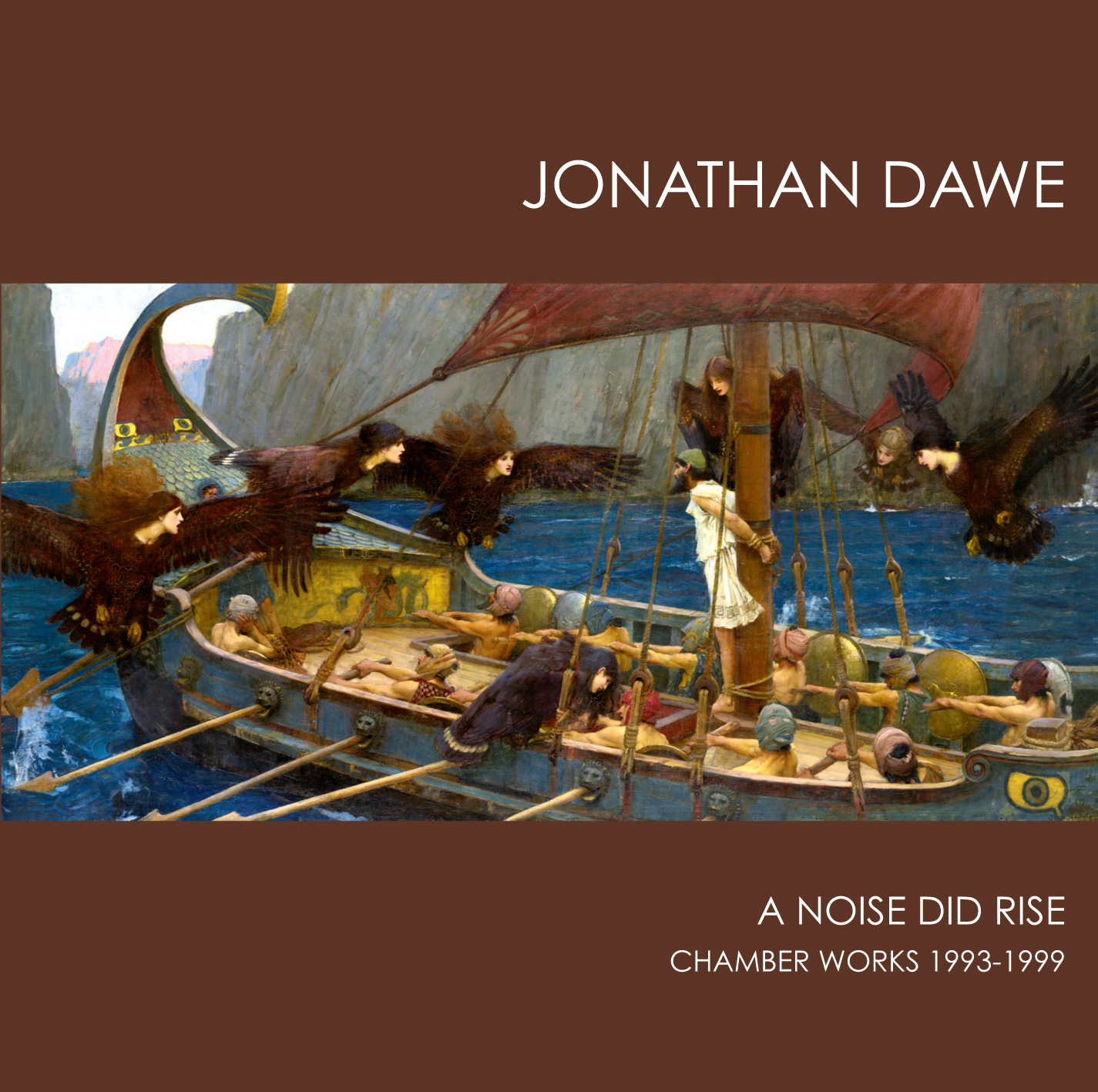
Cover Painting: J.W. Waterhouse (English 1849–1917)
Ulysses and the Sirens, 1891, oil on canvas
100.0 x 201.7 cm, Purchased, 1891
National Gallery of Victoria, Melbourne, Australia
Inlay: Gustave Doré (1832-1883), from the Illustrations for John Milton’s Paradise Lost (II. 949,950), ca .1866
This recording was made possible by the generous support of:
The Aaron Copland Fund for Music
The Puffin Foundation
The Grand Marnier Foundation
Ansonia Music Outreach
and private contributors.
William Anderson plays a Thomas Humphrey F-hole Millennium, 1987
Marc Wolf plays a 2001 Gary Southwell ‘A’ Series.
This is a composer supervised recording.
Special thanks to West Center Church
® & © 2006 furious artisans